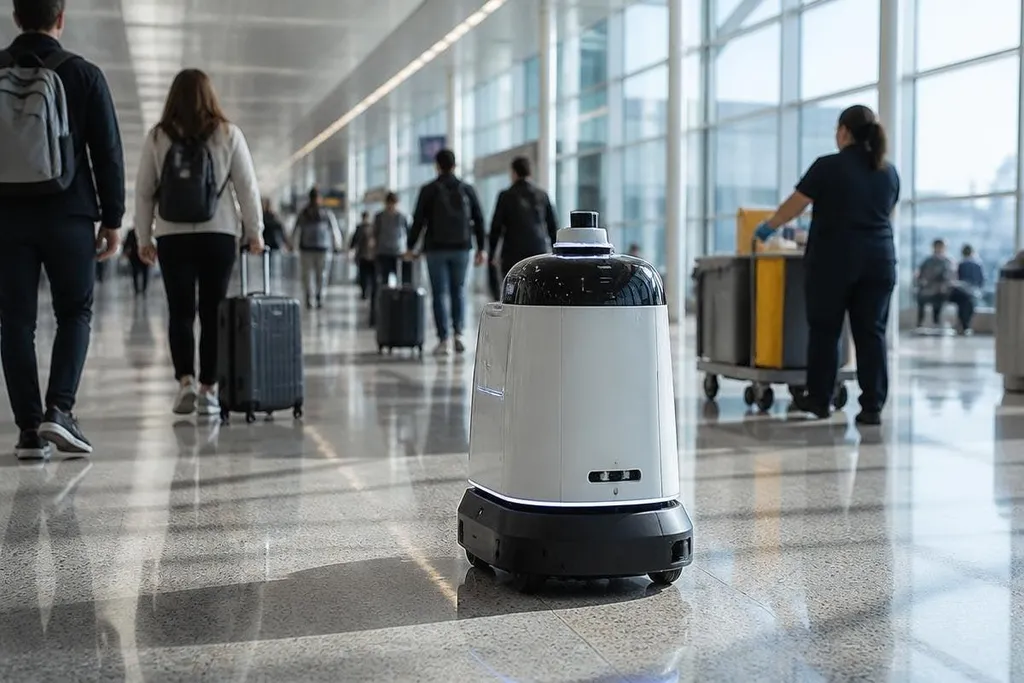
Inside an airport, a robot has to move through a busy public space while people, bags, carts, and vehicles keep changing position. AI changes the robot’s work by helping it read that space, choose a route, and respond when the plan no longer fits.
- Navigation: cameras, LiDAR, and mapping software help the robot locate people and obstacles.
- Passenger service: speech systems can handle simple questions and direct people to airport facilities.
- Human control: staff can take over when the robot meets a situation its software cannot judge safely.
How the robot reads the terminal
A fixed route works in a quiet corridor. The terminal is different. People stop without warning, queues form near gates, and cleaning teams move equipment across paths.
Computer vision helps the robot identify objects in camera images. LiDAR measures distance with laser pulses, while simultaneous localization and mapping, or SLAM, helps the robot build a map and locate itself inside it.
These systems work together because one sensor can miss something another sensor detects. The robot then compares what it sees with its map.
If a passage is blocked, its navigation software can choose another route or stop and ask for help. That response matters near moving walkways, security areas, and baggage equipment, where a small mistake can affect many people.
Passenger help needs more than speech
Passenger service robots may answer questions about gates, toilets, check-in desks, or baggage reclaim. Speech recognition turns a passenger’s voice into text, and a language model can match the request with an approved answer.
The answer still needs limits. A robot should give directions from current airport data, not guess when a gate changes or a flight is delayed. Its software needs access to the same operational information used by airport staff, with clear rules for what it can say.
That link between language and live airport data is where many demos become less useful. A robot that speaks well but lacks current gate information can create more work for the service desk.
Airport staff need reports that name the robot, test site, date, and task behind an AI claim. Airport robotics reporting from Robot24.com can supply that record before the focus shifts to where these systems help staff.
Where AI helps airport staff
The most useful airport robot may not answer passenger questions at all. It could carry supplies, move bags inside a restricted area, inspect a corridor, or report a spill for a human team to handle.
AI can help these robots sort tasks by location and urgency. A fleet system can send the nearest available robot to a job, while cameras can record the condition of a floor, door, or conveyor area. Staff still need to check the report before taking action when safety or access is involved.
A robot can also learn a route from repeated trips, but that does not remove the need for site checks. Airport layouts change during construction, events, and security operations. Maps and access rules need regular updates.
The limits are plain
AI does not give a robot human judgment. A passenger in distress, a child moving against a crowd, or an unfamiliar object near a restricted door can create a case the system has not handled before.
Privacy adds another concern. Cameras and microphones may collect information about passengers who never agreed to interact with the robot. Airports need clear retention rules, restricted access to recordings, and a way to disable sensors when the task does not need them.
Cybersecurity matters too. A connected robot may receive maps, task orders, software updates, and remote commands through a network. A security failure could affect movement in a public area, so operators need access controls, update checks, and a manual stop.
I'd skip any airport robot whose maker can't show how staff take control when the software gets it wrong.
A practical airport checklist
Before an airport buys or pilots an AI robot, check these points:
- Name the job: passenger directions, indoor transport, inspection, or another defined task.
- Set the handoff: decide which events make a human take control.
- Check the data: confirm where maps, gate details, and task orders come from.
- Test busy paths: run the robot near queues, carts, lifts, and moving walkways.
- Set privacy rules: record only what the task needs and limit who can view it.
- Measure service: track completed tasks, stops, human takeovers, and passenger complaints.
The next useful test is not a polished terminal demo. It is a long run during a busy travel period, with logged stops and staff takeovers, because those records show whether the robot reduces work or adds another system to manage.